The Nand Game – Boolean Algebra

http://nandgame.com/

APA Citation:

Build a computer from scratch. (n.d.). Retrieved July 5, 2019, from http://nandgame.com/

Summary:  

Nand is an exercise in thinking logically – mathematically.  One is given a task and series of Boolean gates to complete the task which begin at the basic level of understanding and applying the logic to very complex designing applying logic to solve the challenge.

As one explores the even the basic levels, it is clear that there is more than one way to solve the problem.  The longer a problem is examined, and solutions tried, a more efficient way to solve the challenge emerges – and that is the key to math, finding the easiest way to solve a problem.

Things Learned:

My Question:

This answers my question about mathematical thinking as this it is practice of what Boolean Algebra is and how it operates.  To truly understand math, it needs to be worked and used.

The Computer History Museum

APA Citation:

The Computer History Museum. (2019, July 5). Mountain View, CA. Field experience.

Summary:  

The Computer History Museum in Mountain View is set up to inspire students (and teachers) to understand how computers were developed, and where we are going with them.  Our visit included six exhibitions from the earliest computers (which was developed with the aid of Ada Lovelace, an English mathematician and visionary) to examining the challenges faced with designing self driving  cars (and this idea has been around since the 1950s). 

Along with these exhibitions, there is a hands-on, learning lab where visitors explore problem-solving and designing software, taking apart and putting back together a computer, and see how computers are used to save lives.

Click here to find wonderful resources for classroom use.

Things Learned:

I am intrigued by the story of Ada Lovelace – not only was she involved with building the first mechanical computer in the early 19th century, she is also credited with writing the first algorithm to carry out operations beyond the calculations; the first programmer.

My Question:

This answered my question about mathematical thinking as the history of computers is all about logical thinking and finding patterns.  The Computer History Museum displayed what can be done when mathematical thinking is put into action.

An Unexpected Tool for Understanding Inequality: Abstract Math

APA Citation:

Cheng, E. (March 8, 2019). An unexpected tool for understanding inequality: Abstract math. Retrieved July 4, 2019, from https://www.ted.com/talks/eugenia_cheng_an_unexpected_tool_for_understanding_inequality_abstract_math?language=en#t-608519

Summary:  

Category theory – pure math, mathematical thinking.

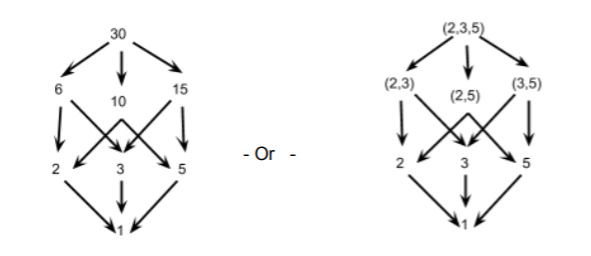
Take a look factors of 30.

Factors of 30: 1, 2, 3, 5, 6, 10, 15, 30

Another look at the factors of 30

The hierarchy is seen – at the bottom two rows are the prime numbers, the third row has two factors and the top number has three.

Eugenia then takes the discussion into a real world aspect – looking at the privilege, starting with:      

Privilege

rich, white, male (30)
rich, white, non-male
(6)
rich, non-white, male
(10)
non-rich, white, male
(15)
rich, non-white, non-male
(2)
non-rich white non-male
(3)
  non-rich, non-white, male
(5)
non-rich, non-white, non-male
(1)


She uses mathematical thinking to examine societies problems – and to understand our world, and our place in it relative to others.

Eugenia shows how abstract mathematics is used to understand and empathise with others in this world.

My Question:

This answers my question about mathematical thinking as Eugenia uses logic and patterns to explore other ways of seeing simple mathematical procedures (finding factors) as well as extending this logical thinking to the world outside of the classroom.

Boolean Algebra

APA Citation: James, J. (2014, June 07). Boolean algebra explained part-1. Retrieved July 2, 2019, from https://www.youtube.com/watch?v=2zRJ1ShMcgA

Summary:  

Boolean Algebra is centered on three operators, or gates: Not, And and Or gates – uses 1 (true) & 0 (false). 

“Not” gates takes only one input and gives the opposite of what is put in (if 0 is input, 1 is returned, and vice versa).  In Boolean notation this is written A.

InputOutput
10
01

“And” gates gives one output from two inputs (input 0, 0 -> output 0; input 0,1 -> output 0; input 1, 0-> output 0; input 1, 1 -> output 1).  In Boolean notation this is written Q = A ∙ B. To have an output of 1, both inputs must be 1. Three inputs are allowed and in order to get an output of 1, all three inputs must be 1.  

Input 1Input 2Output
111
100
010
000

“Or” gates can have two or more inputs.  (input 0, 0 -> output 0; input 0, 1 -> output 1; input 1, 0-> output 1; input 1, 1 -> output 1).  In Boolean notation Q = A + B. To have an output of 1, one of the inputs must be a 1. Three inputs are allowed and in order to get an output of 1, only one if the inputs must be 1.

Input 1Input 2Output
111
101
011
000

Things Learned: 

Boolean operators are based on one of two outcomes and they are well defined: yes or no, true or false, on or off.  This can be applied to think logically and make decisions. 

My Question:

This answers my question about mathematical thinking as logic is needed when using the gates to take a limited number of inputs and use them to find the one output desired.

In Pursuit of the Unknown

APA Citation:

Stewart, I. (2013). Ghosts of departed quantities. In In pursuit of the unknown: 17 equations that changed the world. New York: Basic Books.

Summary:  

In the late 1600s, Newton in England and Leibniz in Germany developed calculus independently at more or less the same time, Newton is known for using it to explain and understand the universe, Leibniz did little with it.  Newton said “if I have seen a little further, it is because I was standing on the shoulders of giants.” referring to the work, going back to ancient Greeks, that had led up to its discovery. More contemporary influences included Wallis, Fermat, Galileo, and Kepler.

Calculus looked at change over time.  Looking at the speed of an automobile, you can use miles per hour.  You get a closer look at an automobile’s speed than MPH, and split it to more accurate – use smaller intervals of time, Miles/Second.  Which is a pretty close look at speed when driving a car, but for a, “guitar string playing middle C vibrates 440 times every second; average its speed over an entire second and you’ll think it’s standing still.” Galileo conducted experiments on the effects of gravity on objects (balls) as they rolled down an incline.  Studying the speed with smaller and smaller intervals. He noticed that a pattern in regards to a balls speed and distance, regardless of the size of the ball or the incline of the ramp.  Newton used these findings, among others, to form calculus – as the interval continues to get smaller, it becomes nearer to the instantaneous rate of change.

Calculus is applied to helps us understand the world and is applied to concepts ranging from deep outer-space travel to back on our home studies of subduction zones that may create an earthquake.  

Things Learned:

Calculus was discovered at, more or less, the same time by two different mathematicians.  One (Newton) used it to describe the world we live in, the other (Leibniz) did little with it.

My Question:

This answers my question about mathematical thinking by learning about the beginning of calculus and how it was developed through the use of mathematical thinking.  These two mathematicians looked for patterns of objects in the and described how they changed using logic and patterns.

What is Category Theory Anyway?

APA Citation:

Bradley, T-D. (2017, January 17). What is category theory anyway? [Web log post]. Retrieved July 1, 2019, from https://www.math3ma.com/blog/what-is-category-theory-anyway

Summary:  

Category theory is a way of taking “birds-eye-view” of the mathematical landscape.  From a high vantage point, patterns can be seen and methods of finding solutions shared.  It is a tool to solve math problems. Move a problem from one discipline (perhaps, algebra) to another discipline (perhaps, geometry), and see the problem with a different angle and find new tools to solve the problem.

The key in category theory is not looking so much at the actual objects but at the relations between them, “connections between seemingly unrelated things.”  Finding these relationships – how collections of objects relate to each other sensibly, is the root of category theory.

(Mathematistan, M. Kuppe)

Things Learned:

Category theory is a way to look at links between types of math problems – how they can be seen with other eyes and solved using other tools.

My Question:

This answers my question about mathematical thinking as it describes category theory and how it logically looks for relations and patterns to solve problems.

What is Calculus?

Davidson, J. (n.d.). What is calculus? Retrieved June 27, 2019, from https://www.sscc.edu/home/jdavidso/mathadvising/AboutCalculus.html

Summary:  

“What is Calculus” explores the creation (or discovery) of the branch of maths.  Calculus is not as tough as it’s reputed to be – with a good understanding of algebra then understanding calculus is the next step.  

A little history – math, arithmetic and geometry have been around since ancient times.  The idea of algebra was around, but the tools (the operations and a number system) had not yet been discovered.  It was not until the 9th century AD that these were available and used by a Persian, al-Khwarizmi, to develop algebra.  But algebra and geometry were not well linked.  

In the late 16th century, Rene Descartes used a graph with two axis (one vertical and the other horizontal) to name the position of objects on the plane.  The position was described using a pair of numbers, the horizontal position was the x’s and the vertical was y’s.  With this, Descartes was able to use algebra to represent geometric objects.

Later, in the 17th century, calculus was developed independently by two mathematicians (Newton and Leibnitz) in the 1670s as a need to understand constant change: the change in the speed of an accelerating object, or the effects of gravity on a falling object – not an average, but the speed at a specific time.  Today, calculus is the foundation for sciences, engineering, and advanced maths.


Things Learned:

Three things needed to be successful in calculus are: the ability to apply algebra skills, understand the concepts (not memorize), and dedication.

My Question:

This answers my question about mathematical thinking by learning about the beginning of calculus and how it was developed through the use of mathematical thinking.  These two mathematicians looked for patterns of objects in the and described how they changed using logic and patterns.
50 Math Ideas You Really Need to Know

APA Citation:

Calculus. (2014). In T. Crilly, 50 maths ideas you really need to know. London, UK: Quercus. 

Summary:  

“Calculus is the central plank of mathematics.”  Beginning with a background in when it began with Newton and Leibniz working independently.  The foundations of calculus involve taking apart (differentials) and putting together (integrals) parts.  Differentiation is measuring change and integration is measuring the area, they work together as inverses of each other.  Calculus is for making accurate predictions without having to run an experiment. Calculus is the math of change, so we can use it to find the speed of a falling object, including acceleration, at any time along its fall.

Things Learned:

Calculus is used outside of the classroom by scientists, engineers, and economists.

My Question: 

This answers my question about mathematical thinking as exploring calculus and learning how it is used to find patterns by breaking things apart or putting them together is thinking logically and looking for patterns – mathematical thinking.

Math is Fun: Introduction to Calculus

APA Citation:

Pierce, Rod. (5 Apr 2018). Introduction to calculus. Retrieved 24 Jun 2019 from http://www.mathsisfun.com/calculus/introduction.html

Summary:  

Calculus has two methods to measure change: differential calculus and integral calculus. Differential calculus breaks something into small pieces to see how it changes and Integral calculus takes small pieces and puts them together to see how much there is; differential and integral calculus are inverse operations.  Differential calculus can be used to find the speed at any given point in time, not just the average speed for the trip. Integral calculus can be used to find the area under a curve.

Things Learned:

Calculus can be used to find the speed of an object at any point along the journey.  Calculus can be used to find the changing volume of an object.

My Question:

This answers my question about mathematical thinking as exploring calculus and learning how it is used to find patterns by breaking things apart or putting them together is thinking logically and looking for patterns – mathematical thinking.