Visual Patterns

APA Citation: 

Visual Patterns. (n.d.). Retrieved July 7, 2019, from http://www.visualpatterns.org/

Summary:  

Visual patterns offers an opportunity for using and developing mathematical thinking.  There are over 250 pattern to examine and use the skills to find an equation for each. Conjecturing, generalizing and convincing can be used to find the patterns.  As in the pattern below:

It appears that the blue stars grow by two each new pattern, but the red star remains at one.  This is handy if we want to figure the stars for the 4th or 5th pattern (just count on), but if we want the 25 or 43 (the 43rd answer is always given), we need to find a generalization.  I know that multiplication can be used to represent repeated addition, and as it is growing by two for each stage, I can multiply the stage number by two for the number of blue stars, and just add one for the red star.  And if I try it with numbers I can easily count (the 4th at 9 stars and the 5th at 11 stars) I can try my generalization: stage 4 is 4(2) + 1 = 8 + 1 or 9 (as above) and stage 5 is 5(2)+ 1 = 10 + 1 or 11 (again as above).  Next is the convincing – if I can go out to 43 (I have the answer for this), then I am feeling confident in the rule. Stage 43 is 43(2) +1 = 86 + 1 or 87 (which matches the answer given).
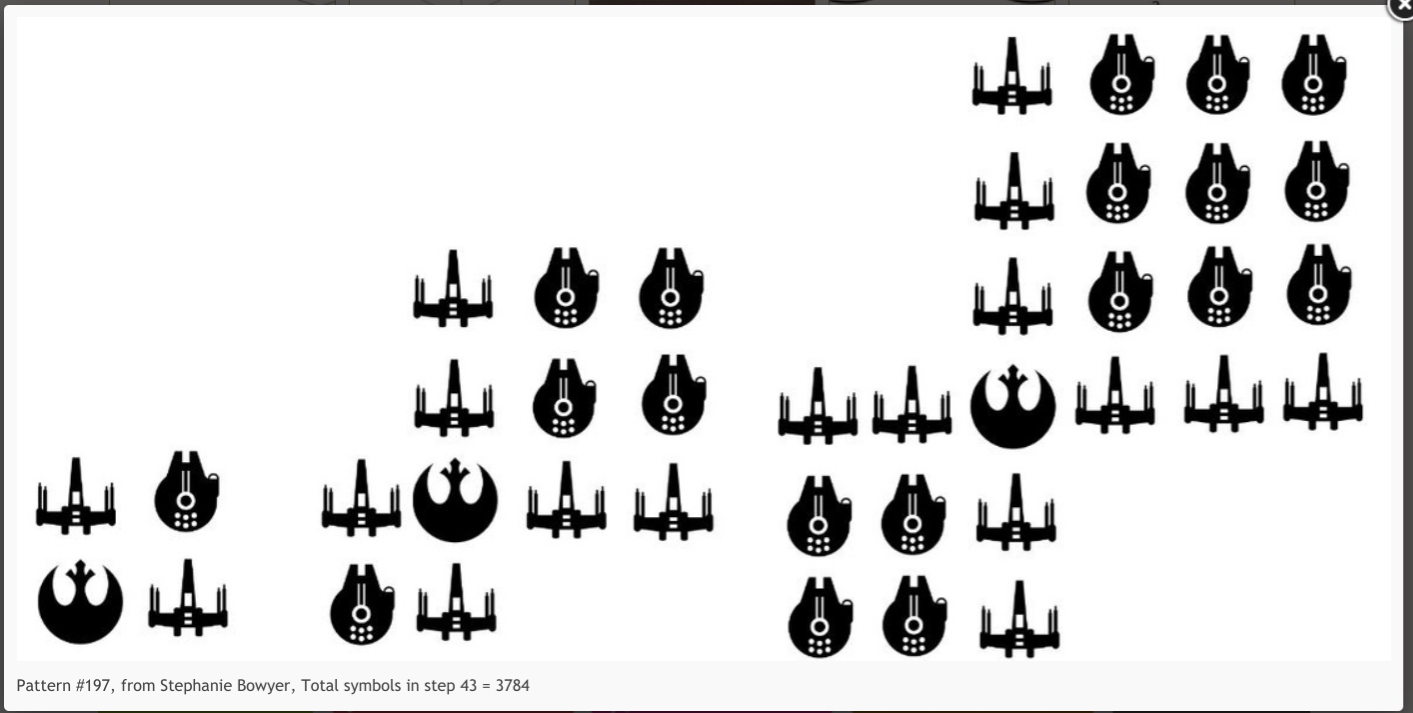
And, they can be quite tricky – but noticing the patterns and seeing the shapes that are growing, led me to try x2 + (x +1)2 – 1.  Trying this with the values I knew first for the three stages given, and when this confirmed the equation worked, I used the value given for step 43, and it was correct.

Things Learned:

I discovered using mathematical thinking, it is possible to find solutions for problems – either basic, or those which are a little tricky.

My Question:

This answers my question about mathematical thinking as this it is practice of using mathematical thinking to solve problems.  To truly understand math, it needs to be worked and used.

Fractal Art

APA Citation:

Fractal Art. (n.d.). Retrieved July 7, 2019, from http://www.arthistory.net/fractal-art/

Summary:  

Fractal art is a relatively new, computer generated art form.  The designs are based on calculations of infinite fractal equations.  As they are the representations of complex mathematical equations, they are not hand-drawn, but created using computer programs.  “This is not the first time art and math have met – ancient mosaics, oriental rugs, and cubist art, for example, demonstrate the links between math and art.” 

This picture displays mathematical thinking – repeated patterns are displayed and to provide an aesthetically pleasing piece.

Things Learned:

Fractal art is only done using computer software.

My Question:

This answers my question about mathematical thinking as fractals are exploring the patterns and finding the beauty in what seems to be chaos.

Mathematical Thinking: The Struggle for Meaning

APA Citation:

Burton, L. (1984). Mathematical thinking: the struggle for meaning. Journal for Research in Mathematics Education,15(1), 35. doi:10.2307/748986

Summary:  

Answers three questions: 

  • “What is mathematical thinking?
  • What does it have to do with mathematical content?
  • Can it be taught?” (p. 35)

Mathematical Thinking:

 “…mathematical thinking is a natural means by which we classify, combine, relate and transform information…” (p. 44)

As the scientific method does not cover any content in science, mathematical thinking is not focused on the content, but how to do math.  In general, the four processes below are central to mathematical thinking. Specializing – examining a particular example. Examples provide concrete, tangible elements.

  1. Conjecturing – after a series of examples, what is noticed about the relationships, what is the connection, the pattern?
  2. Generalizing – can this pattern be generalized to other instances?
  3. Convincing – the generalization must be tested until it is convincing, not just for the one doing the activity, but for the outside world as well.

What Does Mathematical Thinking Have to do With Mathematical Content?  

An example given on p. 42-43, there was a discount of 20% offered on an item and 15% tax on the item.  Would it be better for the purchaser to first calculate the discount or the tax? The initial conjecture was that applying the discount would make the base lower and then apply the tax, so some examples were used to test this theory.

Trying it with $100 dollars and the discount first leaves $80, then a 15% tax is $92.  When tried the tax first, $115, then a 20% discount is $92. This was tried with other amounts $65, and again, it did not matter which was calculated first, the discount or the tax.

With mathematical thinking, one is able to engage – openly inquire and make meaning.  Although learning just the math, this gives a closed answer, an algorithm, it can be used to confirm or deny our conjecture.

Can Mathematical Thinking be Taught?

In order to learn mathematical thinking, one must ask questions, challenge and reflect.  Questions such as, “Why do I think that?”, or “Is there another way?” are just a couple. One also needs to be ready for struggling to find meaning.  

Things Learned:

Mathematical thinking and math are not the same, but math can be used to validate one’s mathematical thinking.

My Question:

This answers my question about mathematical thinking as the author shares examples of what mathematical thinking is – finding patterns and looking for structure.

What is Mathematical Thinking

APA Citation:

Drvcourt. (2016, July 09). What Is mathematical thinking? Retrieved July 7, 2019, from https://drvcourt.wordpress.com/2016/07/08/what-is-mathematical-thinking/

Summary:  

Mathematical thinking is looking at the basic structure or patterns of things.  “Math is about patterns”. Math is about describing something that happens consistently, all the time. And mathematical thinking is not only for math class, it can be used to understand the world – the structures in nature or society too.

The process of thinking mathematically includes these steps – often they are done together:

  • Break task into components
  • Identify similar tasks that may help
  • Identify appropriate knowledge and skills
  • Identify assumptions
  • Select appropriate strategy
  • Consider alternative approaches
  • Look for a pattern or connection
  • Generate examples

Thinking mathematically combines being creative as well as the technique.  When this is done, and a solution is found, it’s time to test it. If your solution is valid, how can this be proved?  If it is not, what changes can you make – if it is unsuccessful, try again. The root of math is asking good questions, thinking deeply, making connections and extending it to further ‘what if’ situations to find, and prove your solution.

Things Learned:

It is important to be persistent – if the solution does not work, go back to the drawing board examine the steps, and see if you can devise a new solution.

My Question:

This answers my question about mathematical thinking as the author defines what mathematical thinking is – finding patterns and looking for structure.

Moebius Noodles

APA Citation:

McManaman, Y., & Droujkova, M. (2013). Moebius noodles: Adventurous math for the playground crowd. Cary, NC: Delta Stream Media.

Summary:  

Moebius Noodles investigates children as natural mathematicians, and to keep this exciting understanding and exploring alive, math needs to be presented as such.  Rich, deep mathematical experiences prepare one for a lifelong love of math. Using everyday items to explore fractals, calculus, and algorithms will start the curiosity at home.  After an introduction outlining the purpose, I was engaged with Moebius Noodles and activities to uncover patterns in symmetry, numbers, functions, and grids.

My goal is to learn how to think mathematically, and I need to start from the beginning.  Interacting with these activities build the foundation of mathematical thinking – the logic, sequence and pattern finding – it is also fun to do so with my 9 year-old son and work with him to develop these tools to see the world.

Things Learned:

After working with the activities, my mind was open to see other possible ways to solve a problem or to interpret the situation and find a method for arriving at an answer.

My Question:

This answers my question about mathematical thinking as this it is practice of using mathematical thinking to solve problems.  To truly understand math, it needs to be worked and used.
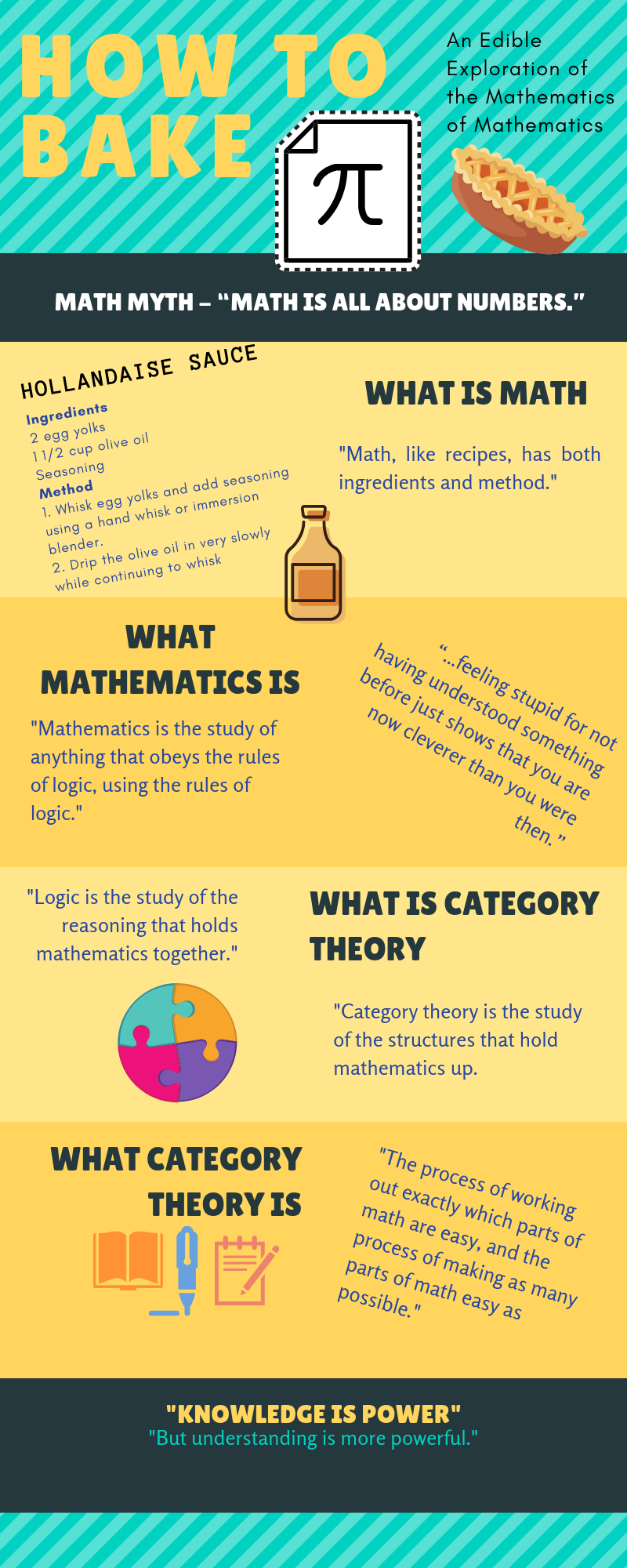
How to Bake Pi

Cheng, E. (2016). How to bake : An edible exploration of the mathematics of mathematics. New York: Basic Books, a member of the Perseus Books Group.

This answers my question about mathematical thinking as Eugenia uses logic and patterns to explore other ways of seeing simple processes as well as extending this logical thinking to the world outside of the classroom.

The Analytic Engine

The Engines. (n.d.). Retrieved July 5, 2019, from https://www.computerhistory.org/babbage/engines/

Summary:  

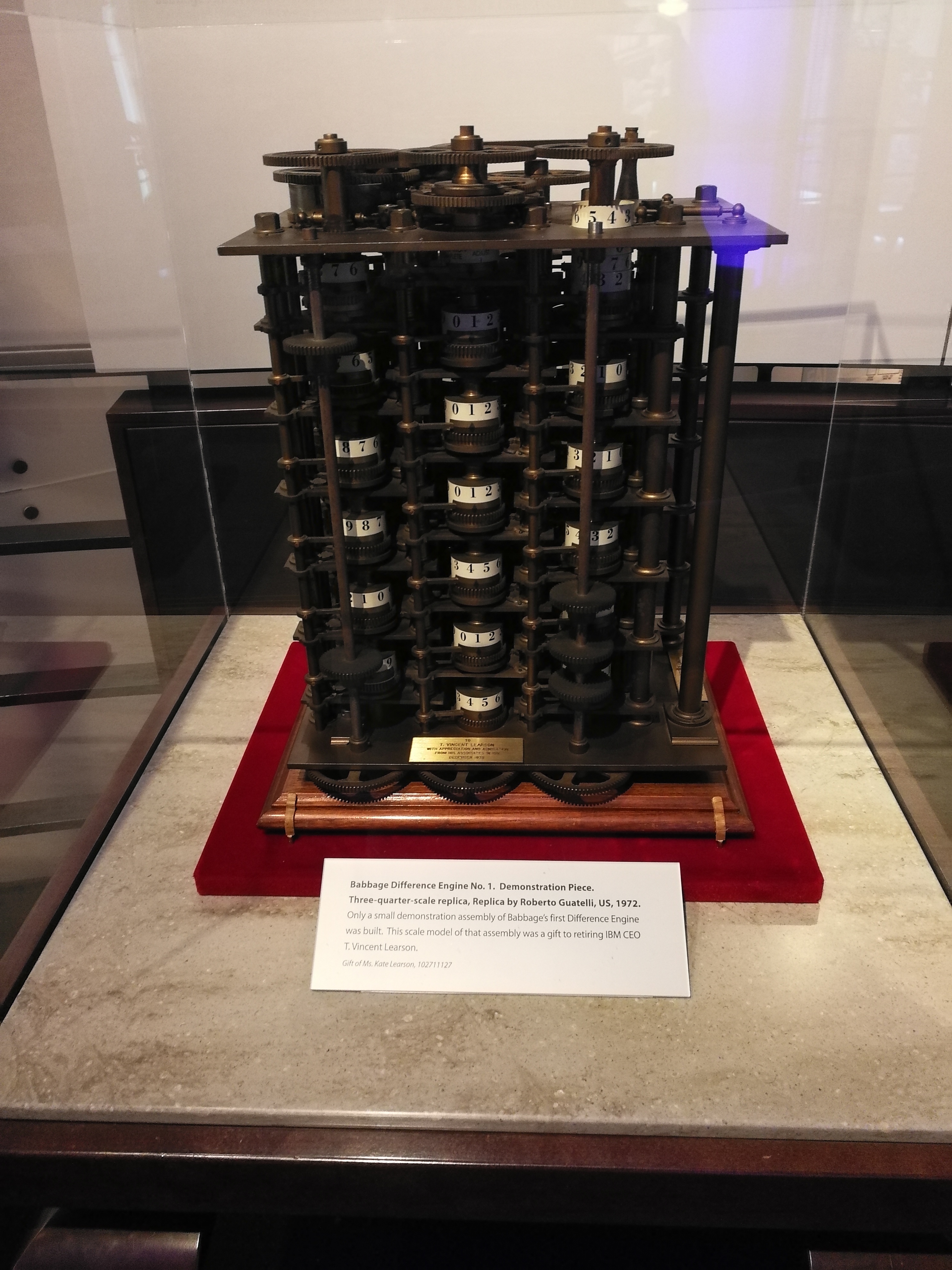
Charles Babbage, one of the first computer pioneers, designed two different types of engines (or mechanical computers).  The Difference Engines did were only for calculations – very simply used addition to calculate the answers. The Analytic Engines were designed for more than calculations, but for general-purpose computations (intricate calculations).  This design had many features found in modern computers: “looping (iteration), microprogramming, parallel processing, iteration, latching, polling, and pulse-shaping…”, to name a few.

Things Learned:

Babbage never did complete a working model; he did have test models and partially completed ones as well as his written designs.  Difference Engine No. 1, was one-seventh complete in his lifetime, and the demonstration piece contained about 2,000 moving parts.

My Question:

This answered my question about mathematical thinking as the history of computers is all about logical thinking and finding patterns.  The Analytic Engine displayed what can be done when mathematical thinking is put into action.

Thinking Mathematically

APA Citation: 

Thinking mathematically. (n.d.). Retrieved July 5, 2019, from https://nrich.maths.org/mathematically

Summary:  

Reading about math, hearing about it or watching video can give a good background, but to truly understand it, one must do the math.  Nrich Maths provides wonderful opportunities to interact with math and mathematical thinking. Activities are designed to build and develop mathematical thinking as well as mathematical habits of mind.

Things Learned:

How does one know if they have found all of the possible answers?  The answer is by working systematically.  

My Question:

This answers my question about mathematical thinking as this it is practice of what Boolean Algebra is and how it operates.  To truly understand math, it needs to be worked and used.
Fractals are SMART: Science, Math and Art!

APA Citation:

Fractals are SMART: science, math and art! (n.d.). Retrieved July 4, 2019, from http://fractalfoundation.org/

Summary:  Fractals are complex, repeating and never-ending geometric patterns.  They are found in nature, art, science and technology. The Koch Curve (pictured below) exhibits how a fractal grows in surface area yet requiring limited space for this.  Fractals have been applied in the design of many things, including antenna for cell phones, cancer research and computer chips.

In abstract math, fractals can make abstract math visual – invoking curiosity instead of fear.  

Things Learned:

Fractals have a finite area and an infinite perimeter.  This allows lungs to maximize the surface area in a small amount of space; this same concept is found in tree leaves.  Fractals have been applied in the design of many things, including antenna for cell phones, cancer research and computer chips.

My Question:

This answers my question about mathematical thinking as fractals are exploring the patterns and finding the logic in what seems to be chaos.

How Mandelbrot’s Fractals Changed the World

APA Citation:

Challoner, J. (2010, October 18). How Mandelbrot’s fractals changed the world. Retrieved July 4, 2019, from https://www.bbc.com/news/magazine-11564766

Summary:  

The term fractal was coined in 1975 by a Polish-born mathematician Benoit Mandelbrot.  Fractal geometry is complex and beautiful – to get an idea of what a fractal is, look at nature.  Fractals are found in clouds, mountains, coastlines, among a multitude of other places. Examining a fractal, one can find the same shape, but smaller, repeated again and again.  A pine tree and notice that it is composed of branches, and each branch is composed of smaller branches, and so on.

The patterns in fractals are not regular (Circles, cones, spheres, etc.) but reflect the irregularity found in the world – “Mandelrot referred to it as ‘roughness’”.  These patterns are used to describe the world and useful when looking into medicine, engineering, genetics, art, as well as computers and describing financial markets.

Things Learned:

Fractals are artistically pleasing, and interesting to look at the world with; I was intrigued to learn that they can be applied to describe financial markets.

My Question:

This answers my question about mathematical thinking as fractals are exploring the patterns and finding the logic in what seems to be chaos.