Moebius Noodles

APA Citation:

McManaman, Y., & Droujkova, M. (2013). Moebius noodles: Adventurous math for the playground crowd. Cary, NC: Delta Stream Media.

Summary:  

Moebius Noodles investigates children as natural mathematicians, and to keep this exciting understanding and exploring alive, math needs to be presented as such.  Rich, deep mathematical experiences prepare one for a lifelong love of math. Using everyday items to explore fractals, calculus, and algorithms will start the curiosity at home.  After an introduction outlining the purpose, I was engaged with Moebius Noodles and activities to uncover patterns in symmetry, numbers, functions, and grids.

My goal is to learn how to think mathematically, and I need to start from the beginning.  Interacting with these activities build the foundation of mathematical thinking – the logic, sequence and pattern finding – it is also fun to do so with my 9 year-old son and work with him to develop these tools to see the world.

Things Learned:

After working with the activities, my mind was open to see other possible ways to solve a problem or to interpret the situation and find a method for arriving at an answer.

My Question:

This answers my question about mathematical thinking as this it is practice of using mathematical thinking to solve problems.  To truly understand math, it needs to be worked and used.
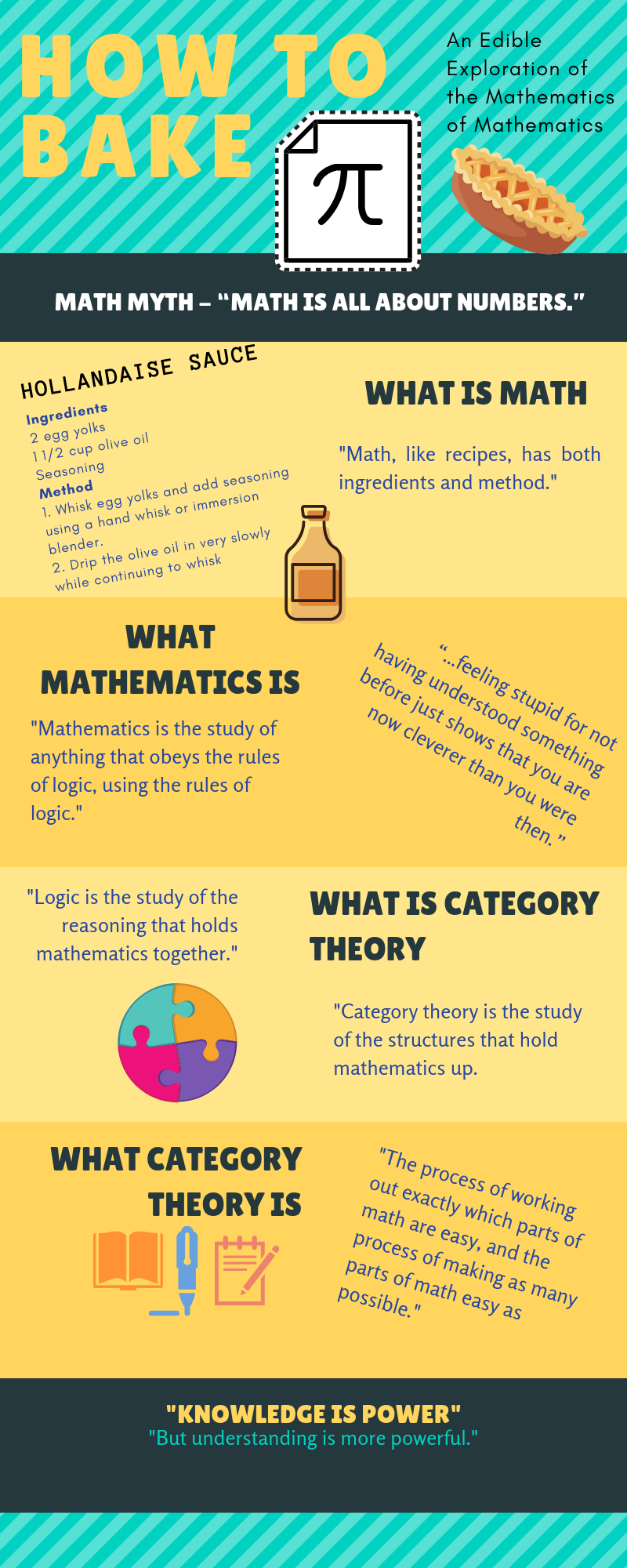
How to Bake Pi

Cheng, E. (2016). How to bake : An edible exploration of the mathematics of mathematics. New York: Basic Books, a member of the Perseus Books Group.

This answers my question about mathematical thinking as Eugenia uses logic and patterns to explore other ways of seeing simple processes as well as extending this logical thinking to the world outside of the classroom.

In Pursuit of the Unknown

APA Citation:

Stewart, I. (2013). Ghosts of departed quantities. In In pursuit of the unknown: 17 equations that changed the world. New York: Basic Books.

Summary:  

In the late 1600s, Newton in England and Leibniz in Germany developed calculus independently at more or less the same time, Newton is known for using it to explain and understand the universe, Leibniz did little with it.  Newton said “if I have seen a little further, it is because I was standing on the shoulders of giants.” referring to the work, going back to ancient Greeks, that had led up to its discovery. More contemporary influences included Wallis, Fermat, Galileo, and Kepler.

Calculus looked at change over time.  Looking at the speed of an automobile, you can use miles per hour.  You get a closer look at an automobile’s speed than MPH, and split it to more accurate – use smaller intervals of time, Miles/Second.  Which is a pretty close look at speed when driving a car, but for a, “guitar string playing middle C vibrates 440 times every second; average its speed over an entire second and you’ll think it’s standing still.” Galileo conducted experiments on the effects of gravity on objects (balls) as they rolled down an incline.  Studying the speed with smaller and smaller intervals. He noticed that a pattern in regards to a balls speed and distance, regardless of the size of the ball or the incline of the ramp.  Newton used these findings, among others, to form calculus – as the interval continues to get smaller, it becomes nearer to the instantaneous rate of change.

Calculus is applied to helps us understand the world and is applied to concepts ranging from deep outer-space travel to back on our home studies of subduction zones that may create an earthquake.  

Things Learned:

Calculus was discovered at, more or less, the same time by two different mathematicians.  One (Newton) used it to describe the world we live in, the other (Leibniz) did little with it.

My Question:

This answers my question about mathematical thinking by learning about the beginning of calculus and how it was developed through the use of mathematical thinking.  These two mathematicians looked for patterns of objects in the and described how they changed using logic and patterns.

50 Math Ideas You Really Need to Know

APA Citation:

Calculus. (2014). In T. Crilly, 50 maths ideas you really need to know. London, UK: Quercus. 

Summary:  

“Calculus is the central plank of mathematics.”  Beginning with a background in when it began with Newton and Leibniz working independently.  The foundations of calculus involve taking apart (differentials) and putting together (integrals) parts.  Differentiation is measuring change and integration is measuring the area, they work together as inverses of each other.  Calculus is for making accurate predictions without having to run an experiment. Calculus is the math of change, so we can use it to find the speed of a falling object, including acceleration, at any time along its fall.

Things Learned:

Calculus is used outside of the classroom by scientists, engineers, and economists.

My Question: 

This answers my question about mathematical thinking as exploring calculus and learning how it is used to find patterns by breaking things apart or putting them together is thinking logically and looking for patterns – mathematical thinking.